Conversation starters are #USvsHate messages that can be used to spark dialogue in classrooms and school communities. They can be messages that challenge us or inspire us. By amplifying “anti-hate” youth voices in schools and publicly, we seek to empower students to build schools and a society where all belong, feel included, and are supported.

Student Backstory Anonymous writes: “I want you to consider something. If the words you said about someone would visually appear on their body, would you still say horrible things? Would you let them walk around with slurs and insults draped upon their shoulders like heavy chains? How would you feel when your mother had insults etched into her skin? When your little sister came home with tears in her eyes as she showed you the slur written across her leg? If the words you said would be as permanent on another’s skin as they were in their heads would you change the way you speak? I think It’s really important to spread positive messages to one another, because the words you say stick around, maybe even forever.”
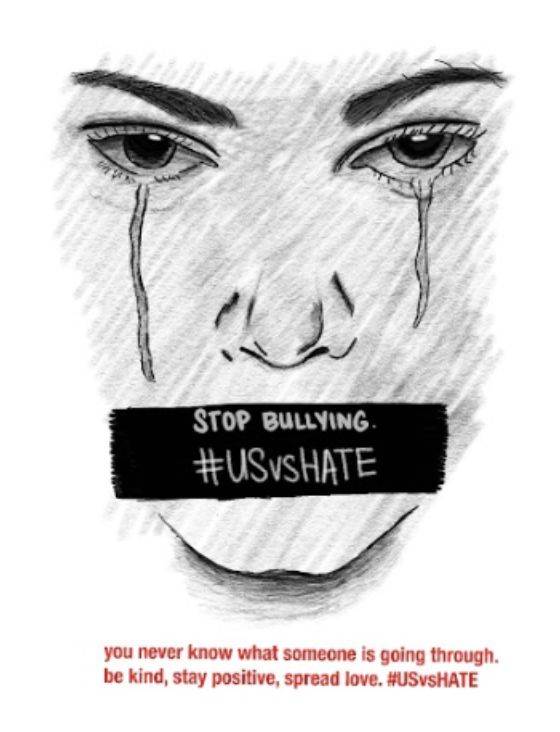
| Student and Teacher Backstories Nyema writes: “You never know what someone is going through. Be kind, stay positive, spread love.” Teacher Lara explains: “We used USvsHate as an introduction to our unit on social inequality. Students were asked to think and discuss issues that they would like to research from a sociological perspective then create a message to raise awareness about their topic of choice.” Analyze the Message and Ask: Why do you think the creator choose to cover the person’s mouth? What do the tears indicate? Why is it important to keep in mind that we don’t know what others are going through? Why should we “be kind, stay positive, and spread love”? |
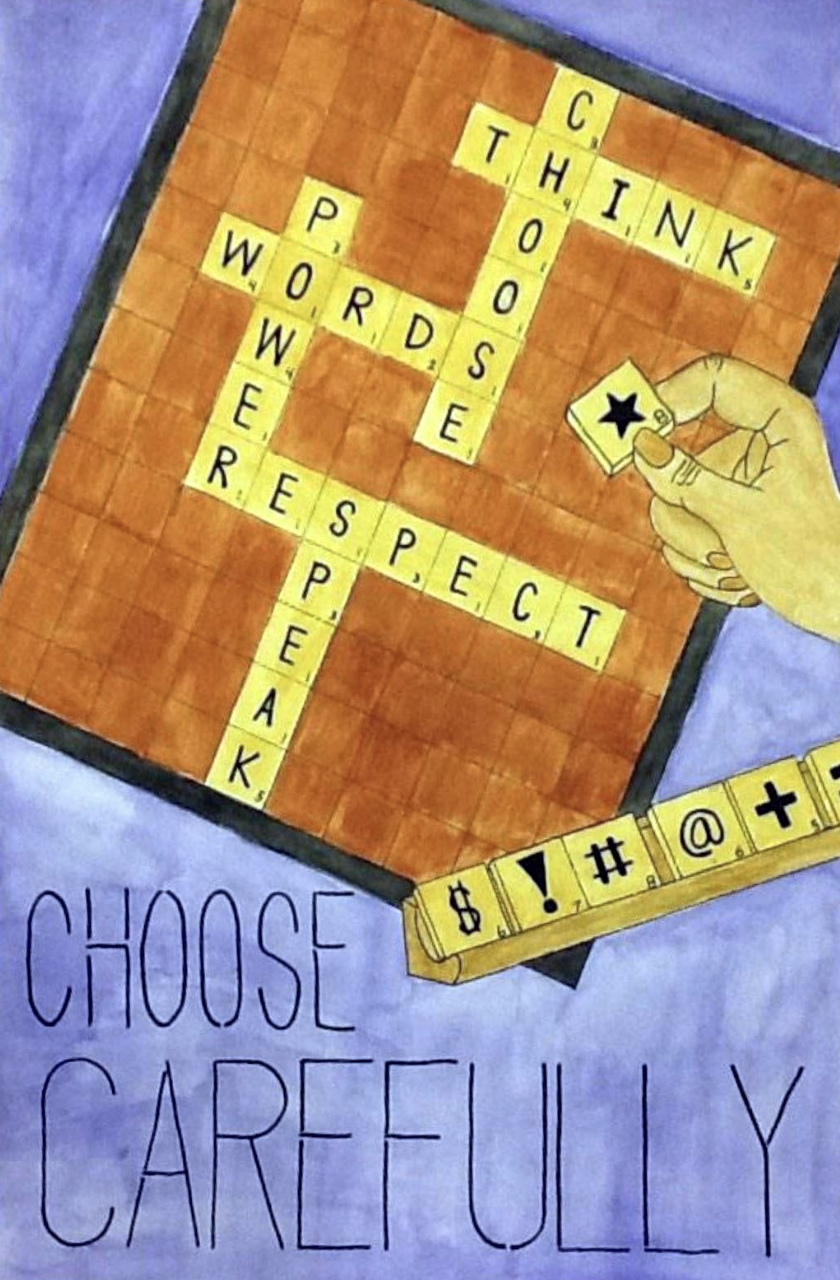
Student Backstory: “…I used a Scrabble board to show the impact words can have on others, and that we have a choice to speak with encouragement instead of hate. The perspective is from the person deciding on what word to use. The scrabble letters…are symbols to represent hurtful curse words that could be made and the symbol tiles have a higher point value (in bottom corner of each tile) to represent the power of language.”
Ask: What makes the words we choose powerful? Why is it important to choose words carefully? How can words be used to heal or hurt someone? How can our words be used to spread kindness—or hatred?

Message Translation: “There are those who see me as weak for being an immigrant but to emigrate you have to be strong.”
Ask: What does the message mean? What story is being told through the images? What do the drawing and message convey together?
Pair with Dreamers by Yuyi Morales. Link to lesson ideas here.
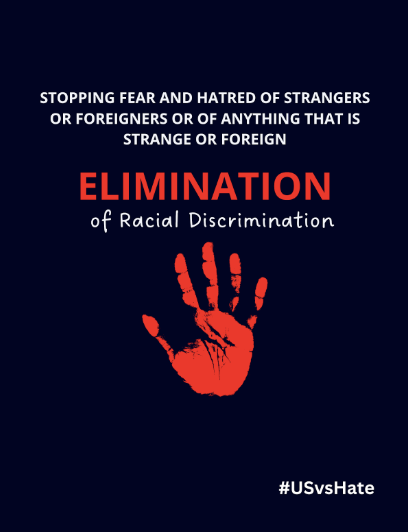
Ask: Why are people afraid of things and people who are unfamiliar? How might we combat these fears? What can we do to help stop discrimination against people who are different from us?
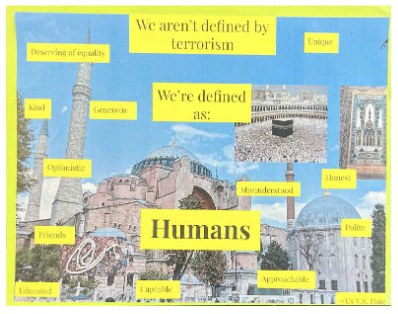
Student Backstory: I am Muslim, and after 9/11 especially Muslims have been given somewhat of a bad rap. People fear Muslims, calling us terrorists, and I wanted to combat that stereotype. I worked with my friend, who wanted the same thing, to create a poster that tells us to look past the stereotypes and see Muslims for who we are, not what political figures want you to see. That is why we created a poster that tells us to not use society’s definition of Muslims, but to define us as humans, too.
Ask: How do stereotypes impact our ability to see people as individuals? Why is it important for us to see all people as humans? Why do you think the artists included the images used?
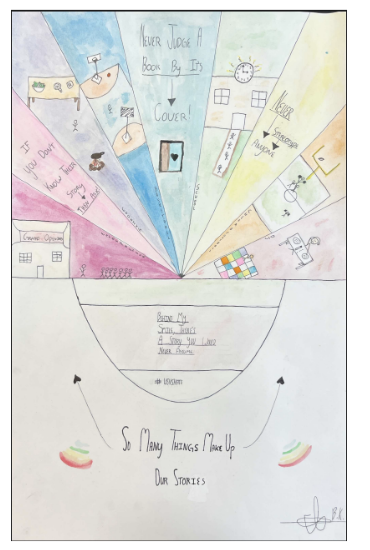
Student Backstory: The backstory to my poster is that we never know what someone’s been through or what their story is like. Before we assume, we should ask.
Ask: What are internal thoughts vs external attitudes? Why is getting to know someone powerful? Why are we quick to judge someone before we get to know them?
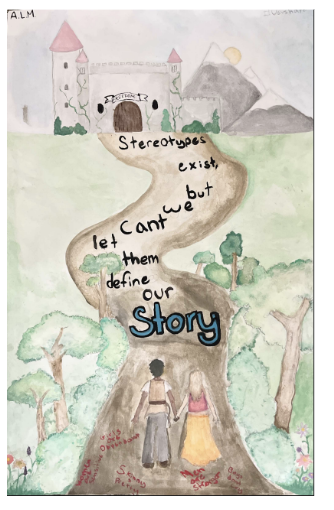
Student Backstory: …we learned a lot about how stereotypes can affect how we as people can view other people around us…. Our quote helps us see how we don’t have to look at people just through stereotypes and that it is important to see people without judging them.
Ask: What are stereotypes? Do you hold any stereotypes about other people? Do you ever feel like people stereotype you? How do stereotypes impact our ability to see people as individuals?
Watch: The Danger of A Single Story — a TEDTalk by Chimamanda Adichie.

Class Backstory: We are a very small but very joyfully diverse class that celebrates and embraces our identities: racial, ethnic, language, and disability identities. In our one class, we identify as African-American, BlAsian, Peruvian, Mexican, Samoan, children of immigrants, and wheelchair users — class as a microcosm of our school, and our school is a microcosm of our beautiful world. We explored the 19th century ideal of the US as a melting pot and decided we preferred the 21st century ideal of a mosaic, celebrating our varied identities as proud Americans.
Ask: What does it mean to be joyfully diverse? What is a microcosm? What is the difference between a melting pot and a mosaic? How does your class celebrate your varied identities?
 SDAWP Voices